Whirlpool Washer LF Error: What It Means and How to Fix It
LF means long fill. The checks a tech runs, in order - most fixes are simple.
Read the fix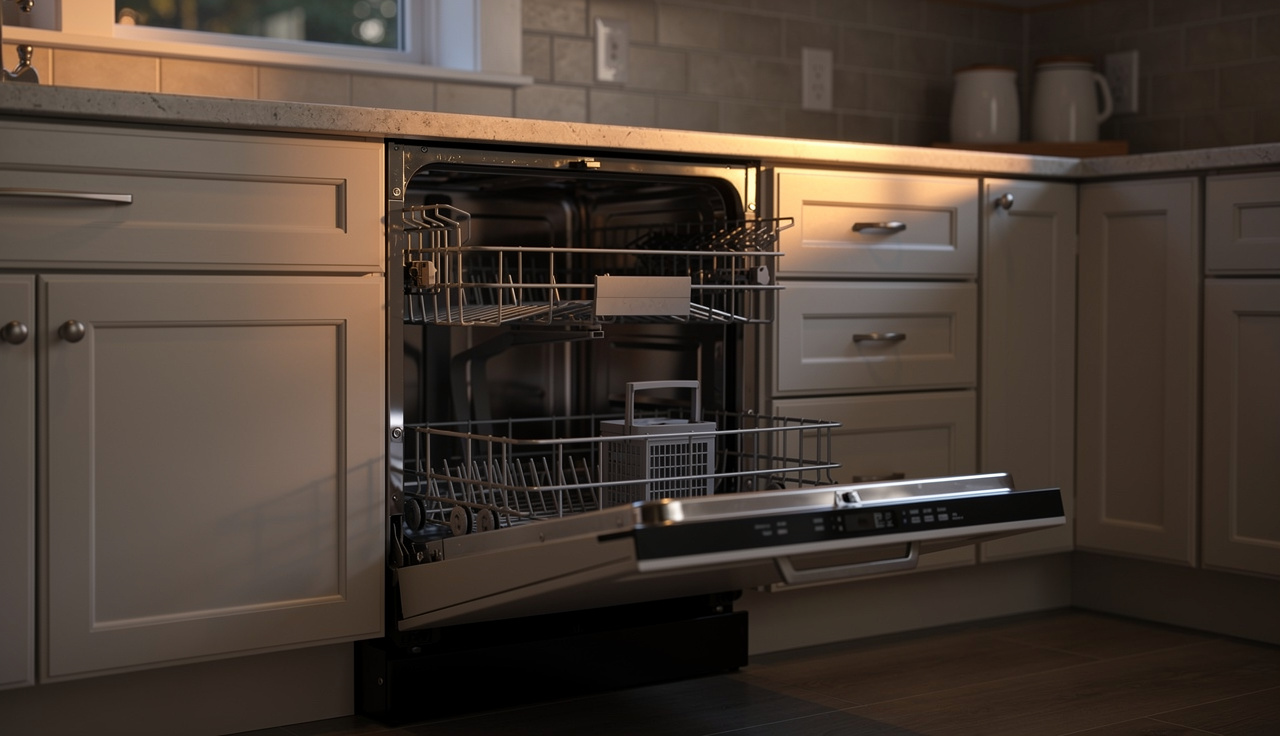
Three beeps on a GE dishwasher — often with blinking lights — usually means the control thinks the door is not latched, or that a cycle was interrupted. It is a status complaint, not a precise diagnosis. Some GE models show C1 or C2-style codes instead of beeps, so check the tech sheet behind the kickplate if your panel has a display.
STOP: These units are hardwired. Before you remove the kickplate or touch any wiring, turn the breaker off and verify with a non-contact tester. If you see standing water in the base or under the unit, treat it as an active leak: shut off the water supply, kill the breaker, and do not run the dishwasher.
This is the number-one cause. The control will not start a cycle unless it sees the door switch closed. A sagging door, a loose strike on the tub frame, or a rack pushed back against the door can keep the latch from engaging. Close the door firmly and listen for a click. Look at the strike where the latch hooks in — if it is loose or worn, adjust or replace it. A latch assembly runs about $25–$60; hinges about $30–$60 for a pair. If the door now latches and the beeping stops when you press Start, you are done.
A hardwired dishwasher has no plug to pull. Flip the breaker off for a full minute, then back on. This clears the control’s memory and resets the door-switch input. If the beeping stops and the unit runs a normal cycle, you had a glitch or a momentary door-switch interruption. If the beeps return immediately, keep going.
Someone may have accidentally locked the panel. Hold the Lock pad for about three seconds, or whatever the tech sheet specifies. The display will usually show LOC or LC. Demo mode is a showroom setting that makes the panel light up without running water. If the unit beeps and lights but never fills, check the manual for the demo-mode exit sequence. This is free to fix and easy to overlook.
On GE models with leak detection, there is a float switch in the base pan. If water collects in the base, the float rises and the control blocks the cycle — often with beeps or a code. That is not a sensor lying. It means there is water where there should not be. Pull the kickplate and look for standing water. If you find it, STOP: shut off the water supply and the breaker. Do not run the unit. Vacuum the water out and find the source — door gasket, hose clamp, pump seal, or tub. A float switch or leak sensor runs about $30–$80, but replacing it will not fix a leak.
With the breaker off, access the door switch at the latch. Use a meter to check continuity with the door open and closed. The switch should change state. If it does not, replace it — usually $15–$40. A failed switch makes the control think the door is open even when it is latched.
Last. If the latch, strike, switch, float, and wiring all check good, the board may not be reading the door circuit. A replacement board runs about $120–$250. Do not start here. Most three-beep complaints are latch alignment or a tripped float.
STOP: If the dishwasher is hardwired and you are not comfortable working in the junction box, turn the breaker off and call a tech. If the base pan is wet, stop running the unit until the leak is found. Water and 120-volt controls do not mix.
LF means long fill. The checks a tech runs, in order - most fixes are simple.
Read the fixLE is a motor lock error. What causes it, what to test, and what is worth replacing.
Read the fixF01 points at the main control board. How to be sure before you spend the money.
Read the fix