Whirlpool Washer LF Error: What It Means and How to Fix It
LF means long fill. The checks a tech runs, in order - most fixes are simple.
Read the fix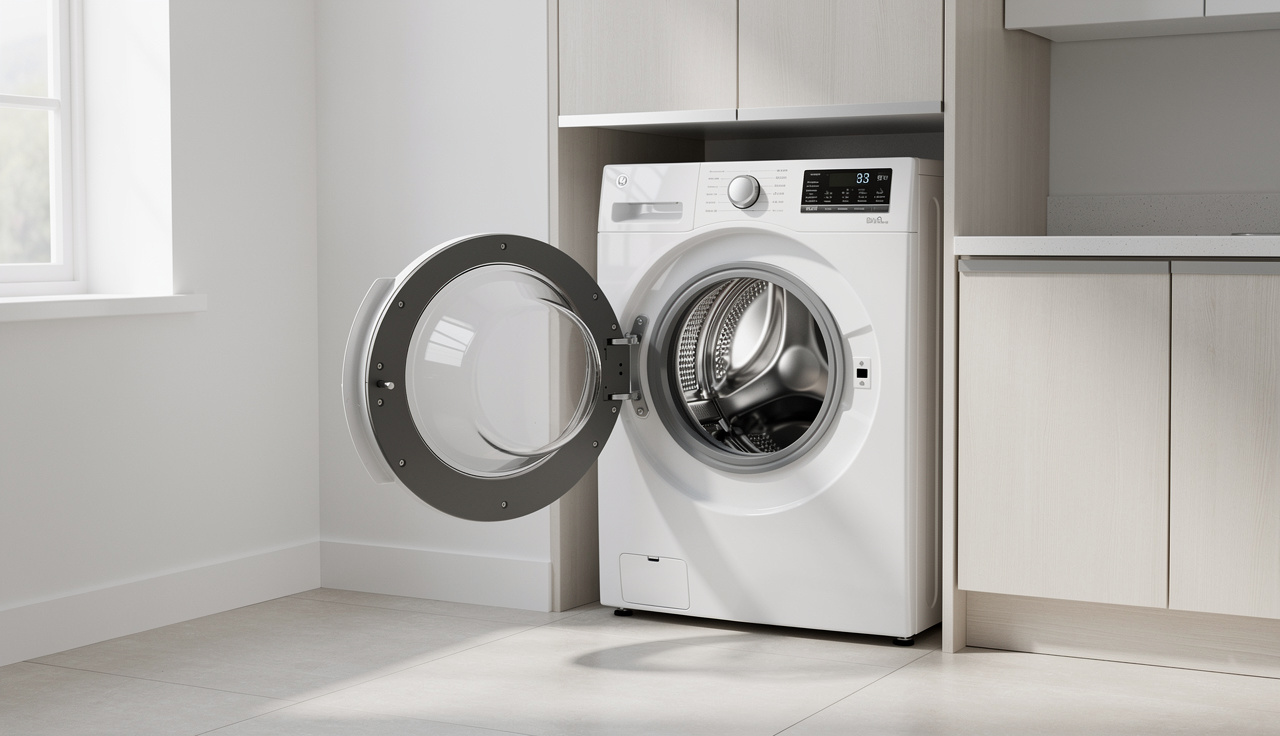
LE on an LG direct-drive washer means “locked motor error.” The control commanded the motor to turn, and the motor either did not confirm rotation or drew more current than the board allows. On these machines the motor is bolted directly to the drum — no belt, no pulley. That changes the diagnostic order. The code can come from a heavy load, a bind in the tub, a bad position sensor, or a motor circuit fault.
STOP: Unplug the washer before you reach into the drum or remove any panel. The inverter board holds a charge after power is off. Wait at least five minutes, and do not touch capacitor terminals or the board’s power section. If you are not trained on inverter electronics, stop at the visual checks.
This is the free fix and the first thing to rule out. A heavy blanket, a large bath mat, or a load packed to the top can drag the drum and trip LE. Open the door, redistribute the load, and run a smaller load. Then run the washer empty on a rinse and spin. If it spins fine empty, the motor and board are probably good and the problem was the load. Check that the washer is level and all four feet are firm on the floor. A walking or rocking machine can throw an unbalanced-load error.
Too much HE detergent, or regular non-HE detergent, creates a cushion of suds. The drum loses its position reference and the board sees a locked motor. Run an empty rinse and spin with no detergent. If you see suds in the drum, run a clean cycle or a second rinse. Use HE detergent only, and use less than the cap suggests — two tablespoons is often enough for a normal load. If the code clears after a suds rinse, you found it.
Unplug the washer. Open the door and push the drum by hand. It should turn with some drag but smoothly. If it will not budge, or you hear grinding, you have a mechanical bind. Common causes are a coin, bra wire, or sock between the inner and outer tub, or a seized bearing. A trapped object sometimes comes out through the drain pump or the top, but often the tub has to be split. A bearing job on an LG front-load is parts around $80–$150 and three to five hours of labor. At $100–$150 per hour, that is roughly $450–$800 total. On an older machine, that math usually says put the money toward a new washer. If the drum has up-and-down play or rust streaks, the bearing is gone.
The hall sensor — also called the position sensor — is the classic LE cause on LG direct-drive washers. It is mounted on the stator at the back of the drum, behind the rotor. It tells the board where the motor is in its rotation. Heat, vibration, and moisture from a weeping bearing kill them. A replacement sensor is usually about $15–$40. Many techs replace it rather than spend time on a full bench test, because the part is cheap and the labor to reach it is the same either way. Check the connector for corrosion and make sure the sensor is seated. If the code follows a known-good sensor swap, the board is not reading it.
Look for chafed wires where the harness passes near the tub, and for corrosion or a loose connector at the motor and hall sensor. With the washer unplugged, check continuity end to end. Wiggle the harness while watching the meter — a reading that jumps means a broken wire inside the insulation. A repair at a connector is cheap. A replacement harness is roughly $30–$80. Do not skip this check; a rubbed wire can mimic a bad sensor or board.
With the rotor removed, inspect the stator windings for burnt varnish or obvious damage. Inspect the rotor for cracked or missing magnets. A stator runs about $80–$160; a rotor about $100–$200. This is less common than the hall sensor but worth a visual check before you buy a board.
Last. If the hall sensor, harness, stator, and rotor all check good, the inverter board may be failing. A replacement board runs about $150–$300. Do not condemn it until every cheaper check is done.
STOP: If the drum has bearing play, rust streaks, or a rumble when turned by hand, stop. That is a mechanical failure, not an electrical one, and the repair cost usually exceeds the machine’s value. If you are not comfortable working around the inverter board, unplug it, wait, and call a tech.
LF means long fill. The checks a tech runs, in order - most fixes are simple.
Read the fixF01 points at the main control board. How to be sure before you spend the money.
Read the fixThree beeps usually means the machine thinks the door is open - or water where it should not be.
Read the fix